
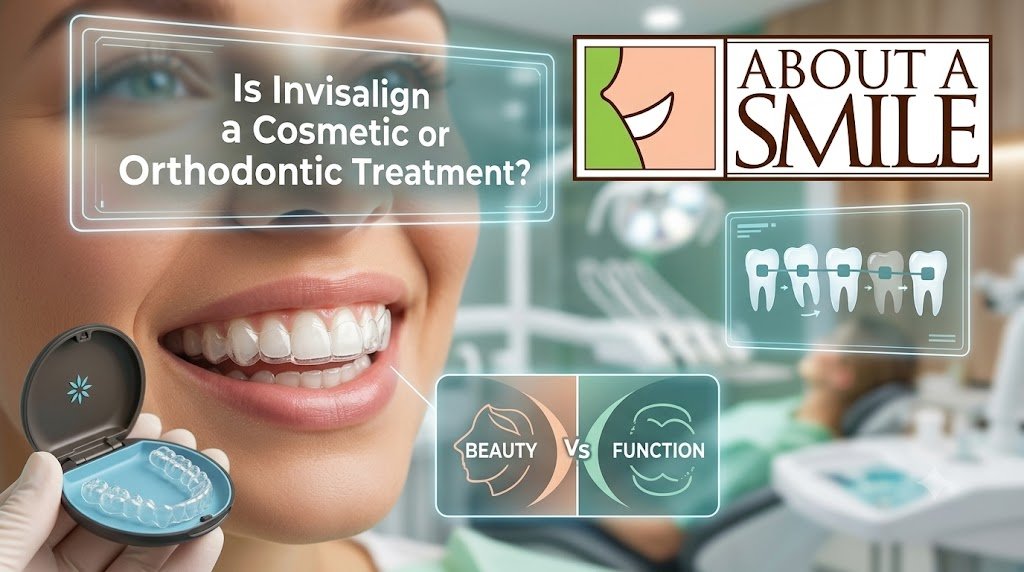
If you want a straighter smile without traditional metal braces, you may have heard about Invisalign. Many people consider Invisalign because the clear aligners are discreet and can improve the appearance of crooked or crowded teeth. But an important question often comes up: Is Invisalign a cosmetic treatment or an orthodontic treatment?
The answer is that Invisalign is primarily an orthodontic treatment. It is designed to gradually move teeth into more desirable positions and can address certain alignment and bite concerns. At the same time, straightening your teeth can create a noticeable cosmetic improvement, which is why many patients also think of Invisalign as a smile-enhancement treatment.
If you are searching for Invisalign Edmonton, understanding this difference can help you decide whether clear aligner treatment matches your goals.
What Is Invisalign?
Invisalign is a clear aligner system used to gradually move teeth. Instead of traditional brackets and wires, treatment uses a series of custom-made, removable clear aligners.
Each aligner is designed to apply controlled pressure to help guide teeth toward their planned positions. Treatment is monitored by a dental professional, who determines whether Invisalign is appropriate for your particular dental needs.
According to Invisalign, clear aligners are designed to address orthodontic concerns such as crowding, spacing, and several types of bite problems.
This means Invisalign is more than simply a cosmetic product that makes teeth look straighter temporarily. It is a form of orthodontic treatment.
Is Invisalign Cosmetic or Orthodontic?
Invisalign Is Primarily Orthodontic
The main purpose of Invisalign is to change the position and alignment of teeth.
Orthodontic treatment focuses on problems such as:
- Crooked teeth
- Crowded teeth
- Gaps between teeth
- Certain bite problems
- Teeth that are not properly aligned
- Some cases involving overbite, underbite, crossbite, or open bite
The exact problems Invisalign can address depend on the individual case and the treatment plan.
Because Invisalign changes tooth position, it falls under orthodontic care.
But Invisalign Can Also Improve Your Smile
Although Invisalign is orthodontic, the results can have an important cosmetic benefit.
Straight, well-aligned teeth can change the overall appearance of your smile. For many patients, improved appearance and confidence are major reasons for considering treatment.
That is why Invisalign can be discussed as part of a broader cosmetic smile plan, even though the actual treatment is orthodontic.
Why Do People Consider Invisalign a Cosmetic Treatment?
The confusion is understandable.
When someone searches for a Best Cosmetic Dentist Edmonton, they may see Invisalign listed alongside teeth whitening and veneers.
All of these treatments can improve the appearance of a smile, but they work differently.
For example:
- Teeth whitening primarily changes the colour of natural teeth.
- Porcelain veneers can change the visible appearance of selected teeth.
- Invisalign gradually moves teeth to improve alignment.
- Restorative treatments can repair or replace damaged teeth.
So, while the end result of Invisalign can be cosmetic, the treatment itself is fundamentally orthodontic.
What Is the Difference Between Cosmetic Dentistry and Orthodontics?
Understanding the difference makes the answer much clearer.
Cosmetic Dentistry
Cosmetic dentistry generally focuses on improving the appearance of your smile.
Depending on the patient’s needs, cosmetic treatments may address:
- Tooth colour
- Tooth shape
- Tooth appearance
- Certain chips
- Certain spacing concerns
- Overall smile aesthetics
For example, professional whitening may be considered when the primary concern is tooth colour.
Veneers may be considered when a patient wants to change the visible appearance of one or more teeth.
Orthodontic Treatment
Orthodontics focuses on the position and alignment of teeth and, depending on the case, the relationship between the upper and lower teeth.
The goal may involve improving:
- Tooth alignment
- Spacing
- Crowding
- Bite relationships
- Tooth positioning
Invisalign belongs primarily in this category.
This distinction is important because straightening teeth can improve both function and appearance.
Can Invisalign Improve the Appearance of Your Smile?
Yes.
One of the biggest reasons people choose Invisalign is that they want a straighter-looking smile without traditional braces.
When teeth are crowded, rotated, or spaced unevenly, improving their alignment can create a more balanced appearance.
The cosmetic improvement may be especially noticeable when the front teeth are involved.
However, every patient’s starting point is different. The final result depends on factors such as tooth position, bite, treatment complexity, and how consistently the aligners are worn.
Invisalign itself notes that treatment times and results vary depending on the complexity of an individual case.
Invisalign vs. Teeth Whitening
Invisalign and teeth whitening can both contribute to a more attractive smile, but they solve completely different problems.
Invisalign Addresses Alignment
If your teeth are crooked, crowded, or spaced unevenly, whitening will not move them.
Invisalign is designed to gradually reposition teeth.
Whitening Addresses Colour
If your teeth are well aligned but look yellow or stained, Invisalign will not whiten them.
Professional Teeth Whitening Edmonton may be a more appropriate cosmetic option when tooth colour is the primary concern.
This is why it is important to identify the actual problem before choosing a cosmetic or orthodontic treatment.
Invisalign vs. Porcelain Veneers
Another common comparison is Invisalign versus veneers.
Both can create a straighter-looking smile, but they achieve that result in different ways.
Invisalign Moves Your Natural Teeth
Invisalign gradually changes the position of your natural teeth.
It does not simply cover the visible surface of the teeth to create the appearance of alignment.
Veneers Change Visible Tooth Appearance
Porcelain Veneers Edmonton may be considered when a patient wants to address several visible characteristics of their teeth.
Depending on the situation, veneers can change the appearance of tooth colour, shape, size, or proportion.
Which One Is Better?
Neither is automatically better.
If your main concern is tooth alignment, orthodontic treatment may be more appropriate.
If your teeth are generally aligned but you have concerns about their visible shape or colour, cosmetic dentistry may be more relevant.
In some cases, a dentist may recommend a combination or a specific sequence of treatments.
Can Invisalign Be Part of a Smile Makeover?
Yes, Invisalign can sometimes be included in a broader smile improvement plan.
A Smile Makeover Edmonton treatment plan can involve different procedures depending on the patient’s individual goals.
For example, someone may want to:
- Improve tooth alignment.
- Address tooth colour.
- Improve the appearance of selected teeth.
- Create a more balanced overall smile.
In such a case, orthodontic treatment could potentially be considered alongside other cosmetic services.
However, a smile makeover is not one standard procedure. Each plan should be customized according to the patient’s oral health, dental structure, and goals.
What Dental Problems Can Invisalign Help With?
Invisalign is designed to address a variety of orthodontic concerns.
These may include:
Crowded Teeth
When there is not enough space for teeth to sit properly, they can overlap or appear crowded.
Orthodontic treatment can help create a more organized alignment when appropriate.
Gaps Between Teeth
Spaces between teeth can occur for different reasons. Invisalign may be used in suitable cases to gradually close certain gaps.
Crooked Teeth
Teeth that are rotated or positioned unevenly may sometimes be improved with clear aligner treatment.
Certain Bite Problems
Depending on the case, clear aligner treatment may be used for certain bite concerns.
However, not every orthodontic problem is suitable for Invisalign. A dental professional needs to evaluate your individual case before recommending treatment.
Does Invisalign Improve Oral Health Too?
Straightening teeth is not only about appearance.
When teeth are crowded or difficult to access, maintaining good brushing and flossing habits can sometimes be more challenging.
Improving alignment may make some areas easier to clean. Orthodontic treatment may also be planned around bite and functional concerns, not just aesthetics.
That is another reason it is more accurate to describe Invisalign as orthodontic treatment rather than simply cosmetic dentistry.
The goal should be a healthy, functional, well-aligned smile—not just teeth that look straighter in photographs.
Is Invisalign Better Than Traditional Braces?
Invisalign and traditional braces are both orthodontic treatment options, but they work differently.
Invisalign uses clear, removable aligners, while traditional braces use brackets and wires.
Some patients prefer Invisalign because the aligners are discreet and can be removed for eating and oral hygiene. Invisalign’s official patient information also highlights the removable and transparent nature of its aligners.
However, Invisalign is not automatically the right choice for everyone.
The best treatment depends on your specific orthodontic needs.
How Does Invisalign Treatment Work?
The exact process varies by patient, but Invisalign treatment generally involves several stages.
1. Initial Consultation
Your dentist evaluates your teeth, bite, oral health, and alignment concerns.
This helps determine whether clear aligner treatment may be suitable.
2. Treatment Planning
A customized treatment plan is developed based on your teeth and desired outcome.
Digital scanning and treatment-planning technology may be used to visualize tooth movement.
3. Custom Aligners
You receive a series of aligners designed for different stages of your treatment.
Each stage is intended to gradually move your teeth according to the treatment plan.
4. Regular Monitoring
Your dental professional monitors your progress and determines whether treatment is progressing as planned.
5. Retention
After active treatment is complete, retainers are generally important for maintaining the new tooth positions.
Invisalign also describes retention as an important part of maintaining the result after active treatment.
How Long Does Invisalign Take?
There is no single treatment timeline that applies to everyone.
Treatment length depends on factors such as:
- The complexity of your case
- The amount of tooth movement required
- Your individual treatment plan
- How consistently you wear the aligners
- Your response to treatment
Some patients may see visible changes relatively early, but that does not mean every case will be completed within the same timeframe.
Your dentist can provide a more realistic estimate after evaluating your smile.
Who May Be a Candidate for Invisalign?
Invisalign can be used for many patients, including adults and teenagers, depending on their individual dental needs.
However, candidacy is not determined simply by age or by wanting straighter teeth.
A dental professional may consider:
- Your tooth alignment
- Your bite
- Your gum health
- Your overall oral health
- The complexity of the movement required
- Your ability to follow the treatment instructions
Invisalign’s official information states that treatment can be used for children, teens, and adults, while also noting that suitability depends on the individual case.
What If You Want Whiter and Straighter Teeth?
You do not necessarily have to choose between alignment and tooth colour.
Some patients are interested in both.
For example, a person may have:
- Crooked but healthy teeth
- Mild tooth discolouration
- Uneven spacing
- A desire for a brighter smile
In this situation, your dentist can assess your goals and determine whether orthodontic treatment, cosmetic treatment, or a combination makes sense.
The important point is to address alignment and tooth colour as separate concerns rather than expecting one treatment to solve everything.
Why Choose a Cosmetic Dentist for Invisalign?
If your goal is not only to straighten your teeth but also to improve your overall smile, working with a dentist who understands both orthodontic and cosmetic considerations can be helpful.
A cosmetic-focused consultation can consider the overall appearance of your smile while the orthodontic treatment focuses on tooth movement and alignment.
About A Smile provides cosmetic dental care as well as Invisalign treatment in Edmonton. The clinic describes its services as including cosmetic dentistry, Invisalign, restorative care, emergency dentistry, and family dentistry.
This broader perspective can be useful when your goal is a confident, healthy smile rather than simply moving individual teeth.
Is Invisalign Right for Your Smile?
The best way to answer this question is to look at what you want to change.
Invisalign May Be Worth Considering If:
- Your teeth are crowded.
- Your teeth are crooked.
- You have certain spaces between teeth.
- You have certain bite concerns.
- You want a discreet orthodontic option.
- You want to improve both alignment and smile appearance.
Cosmetic Dentistry May Be More Appropriate If:
- Your teeth are already well aligned.
- Your main concern is tooth colour.
- You want to change the visible shape of certain teeth.
- You are interested in veneers.
- You want to address several cosmetic concerns that tooth movement alone cannot fix.
In some cases, both orthodontic and cosmetic treatment may be considered.
Frequently Asked Questions
Is Invisalign a cosmetic treatment?
Invisalign is primarily an orthodontic treatment because it is designed to move teeth and improve their alignment. However, the resulting straighter smile can provide significant cosmetic benefits.
Is Invisalign considered orthodontics?
Yes. Invisalign is a clear aligner orthodontic treatment. It is used to gradually move teeth and can address various alignment and bite concerns in suitable cases.
Is Invisalign better than veneers?
Neither treatment is universally better. Invisalign moves teeth into improved positions, while veneers change the visible appearance of selected teeth. The appropriate option depends on your dental needs and goals.
Can Invisalign whiten teeth?
No. Invisalign is designed to move teeth, not whiten them. If tooth colour is your concern, professional teeth whitening may be discussed separately.
Can Invisalign fix crooked teeth?
Invisalign can treat many cases of crooked or crowded teeth. However, suitability depends on the severity and type of tooth movement required.
Can Invisalign be part of a smile makeover?
Yes. Invisalign may be incorporated into a broader smile improvement plan when tooth alignment is one of the patient’s concerns.
Is Invisalign only for adults?
No. Invisalign treatment can be available for children, teens, and adults depending on their dental and orthodontic needs.
Do I still need retainers after Invisalign?
Retention is generally an important part of maintaining your results after active orthodontic treatment. Your dental professional can recommend the appropriate type and wear schedule.
How do I know whether Invisalign is right for me?
A consultation is the best way to determine whether Invisalign is appropriate. Your dentist can evaluate your teeth, bite, oral health, and treatment goals before recommending an option.
Improve Your Smile With the Right Treatment
So, is Invisalign a cosmetic or orthodontic treatment?
The most accurate answer is orthodontic treatment with cosmetic benefits.
Invisalign is designed to move teeth and improve alignment, making it fundamentally different from treatments such as teeth whitening or veneers. At the same time, straighter teeth can significantly improve the appearance of your smile and may increase your confidence.
If you are considering Invisalign Edmonton, a personalized consultation can help you understand whether clear aligners are suitable for your smile.
At About A Smile, the goal is to create personalized dental care based on your individual needs rather than recommending a one-size-fits-all solution.
About A Smile
307 Dechene Way, Edmonton, AB T6M 2M6
Phone: 780-444-1118
Email: aboutasmile183@gmail.com
Ready to discuss your smile goals? Book a New Appointment with About A Smile to explore your treatment options.
You can also Contact About A Smile if you have questions about Invisalign or other cosmetic dental services.
